Tables for common rooms, canteens, and town halls: what to look for before buying

Tight budgets, strict regulations, heavy use: equipping a public institution with tables is no simple task. At Restootab, we supply town halls, schools, multi-purpose halls, and meeting spaces. Here are the criteria we advise them to consider.


  • salle de réunion de collectivité, avec table en bois stratifié restootab

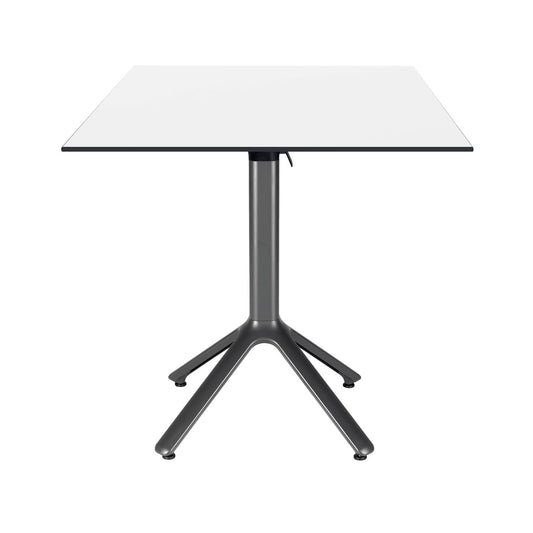
    Rectangular folding Tambu table, ideal for institutional settings, meeting rooms, cafeterias...

  • In a multi-purpose room, a table is used on Mondays for a neighborhood meeting, on Wednesdays for a community group workshop, and on Saturdays for a banquet. Each day, it is moved or cleaned with sometimes harsh products. For technical services, the choice often comes down to a trade-off between the listed price and the promised lifespan.

  • Total cost rather than the price tag

    An entry-level table that shows signs of wear after two or three years (peeling edges, scratched tabletop, warped legs) ends up costing more than the initial purchase of a sturdier model. The right way to look at it is the total cost: purchase price, maintenance, replacement, and what happens to the furniture at the end of its life.

    This last point has become a requirement. Article 58 of the AGEC law requires the State and local authorities to allocate a portion of their annual purchases to products made from reused or recycled materials, ranging from 20% to 100% depending on the product (decree of March 9, 2021). For office furniture, the State Procurement Directorate has set a target of 20% from reused products in 2024, rising to 25% by 2030, in addition to a separate target of 15% recycled material:

    The particleboard panels used in our tables are produced by Swiss Krono, whose factory in Sully-sur-Loire states that approximately 65% of the wood in its raw material mix is recycled.

  • comparaison de table de collectivité en bois agloméré stratifié bas de gamme haut de gamme

    Cheap communal table, compared to a durable communal table

  • Which standard for which table?

    There is no single "institutional table" standard. The applicable text depends on the use.

    • Tables for non-domestic use (multipurpose rooms, meetings, catering): the European standard EN 15372 (2023 edition) sets the requirements for safety, strength and durability, including finger entrapment tests. It excludes desks, tables for educational institutions and outdoor tables, and does not cover resistance to ageing.
    • School tables: the EN 1729 series. Part 1 determines the size according to the student's stature, Part 2 sets the safety and stability requirements. The NF Mobilier Éducation certification attests to compliance with safety, durability and comfort requirements for educational institutions.
    • Public access buildings: the fire safety regulations (decree of 25 June 1980) devote a chapter to interior fittings, decoration and furniture. The safety commission remains the point of contact to find out what applies to each establishment.

    These standards assess the finished table. Material data sheets describe the components. Our tables are now based on the documentation of their components.

  • Vue éclatée de table restootab, en bois aggloméré, stratifié pour espaces publics

    Anatomy of a Tambu Table

  • Anatomy of a Restootab table

    Our tables are made of laminated particleboard, a cost-effective choice widely used in public facilities. They are manufactured by a French manufacturer, and their legs are made in Italy. Technical documentation for each component is available upon request.
    The panel. The core of the table is a P3-type particleboard panel, designed for indoor use. Its declaration of performance indicates a bending strength of 14 N/mm² for thicknesses of 13 to 20 mm and 12 N/mm² for 20 to 25 mm, swelling after 24 hours of immersion limited to 13-14%, formaldehyde emissions in class E1, and a fire rating of D-s2,d0 for the panel alone. This rating is for the panel, not the assembled table.

    The laminate. The tabletop is covered with a high-pressure laminate (HPL), whose technical data sheet indicates wear resistance of at least 150 cycles for solid colors, stain resistance of at least 4 to 5 depending on the product groups tested, a successful NSF/ANSI 35 hygiene test, and a Greenguard certification for low chemical emissions (total VOCs ≤ 0.25 mg/m³). This data is relevant for canteens and schools, where maintenance is frequent and air quality is monitored. The data sheet itself reminds us that fire performance depends on the final assembly with the substrate.

    The leg. Made in Italy, our legs receive a powder coating. The safety data sheet of the product used indicates that it is not classified as hazardous under the CLP regulation, that it does not emit any VOCs, and that it does not contain any SVHC substances above 0.1%. This is a safety document for the paint workshop: it does not measure the durability of the leg during use.

    Sources: AFNOR / Genorma (EN 15372:2023); State Procurement Directorate; Acteurs Publics; L'Info Durable; Valdelia (art. 58 AGEC); Légifrance (ERP regulation); Swiss Krono technical data sheets (DoP P3 MH), Arpa Industriale (Thin Postforming), and Pulverit (SDS Pulverit 28 EPE).

  • What our tables cannot do

    Let's be transparent about the limitations. Laminated particleboard is susceptible to water ingress through the edges, which is the weakness most frequently reported by technical services. A damaged tabletop is difficult to repair. And the quality of bonding, edging, and assembly is just as important as that of the materials—which is why we work with a manufacturer with over 30 years of experience in manufacturing laminated particleboard panels.

    If you are preparing a tender, contact us: we will send you the technical data sheets for our components and answer your questions about what our tables can and cannot do.

    FAQ: Tables for community halls, canteens, and town halls: what to look for before buying

    • Why consider the total cost rather than the purchase price? A cheap entry-level table wears out in 2 or 3 years. Calculating the total cost (purchase, maintenance, replacement, end of life) helps avoid repeated expenses and ensures compliance with the recycling quotas of the AGEC law.
    • Which standards should be followed depending on the use of a table in a public facility? EN 15372: for multipurpose halls, meeting rooms, and canteens. EN 1729 series: for school tables. ERP regulations: for fire safety requirements.
    • What are the weaknesses of laminated particleboard? Its main enemy is water ingress through the edges, which can damage the tabletop. The quality of assembly and bonding is therefore just as important as that of the components. Our French partner guarantees us edge finishes of excellent quality.